Following the trend (and why you shouldn't weigh once per week)
Sat, Oct 10, 2015One of the approaches to diet that I followed in the past was John Walker’s The Hacker’s Diet. This diet is very appealing to engineers and similarly technically minded people as it provides a quantative approach to weight loss. Having done a lot more research and experimentation since then however, I no longer believe that this is an effective approach to gaining health, although for weight loss (and the benefits that come with that anywa) it will work, if you can keep to it. I’ll write more about this in another post but the reason I believe it doesn’t work for health is that it focuses on controlling calories, not their source. One thing that makes it harder to follow is the fact that by focusing on the calories you can eat something very small and calorically dense, but still feel hungry and thus you’ll be fighting your hunger drive which is not really a fun thing.
Now all that said, he does teach a very powerful technique that can help avoid the ups and downs on the scales. In particular he borrows from finance, when he looks at the weight trend and not the individual weights themselves. The problem with scales is that they don’t really tell us what we want to know. We want to know, has the amount of fat stored in our bodies gone down. Even so called “smart” scales that try to calculate fat percentage are far from accurate with wild swings in the order of several percent. What scales actually show us is our total mass and its impact on the Earth’s gravitational field. Specifically it also only counts for the precise second the reading is taken. Come back in an hour and your weight will likely be different.
This is because weight takes into account everything in the body. This includes food, water, the contents of your digestive tract and many other things. If you eat some salty food for instance, your body will store more water to dilute it. This can easily add half a kilo or more to your weight, even if the food was only a few grams itself. The human body does not run to a precise schedule, and as such reading vary throughout the day. In other words a single session on the scales is not at all representative of your actual performance, and most people can easily see weight swings of a few kilos in any direction over the course of a couple of days. So what we need is a filter, an approach to smooth out the noise and see what’s really going on.
I won’t go into all the details here because John does an amazing job of explaining it and showing how it benefits the dieter. He uses an exponential moving average (EMA) to plot the trend of weight loss. This smooths out the spikes and shows a far more accurate (and less depressing) view on how the diet is going.
Weighing once a week
Many diet plans or groups advocate not weighing on a daily basis. A big part of that is to try to avoid the rollercoaster emotions as the scale goes up and down over the course of the week. The theory is that by only weighing once a week, assuming that you’ve followed your diet, you should have lost enough weight that the daily fluctuations won’t matter. In other words, it’s filtering out the noise by sampling less often.
Now this works in theory and admittedly for most of the time in practice. However it is quite possible that you could have lost weight all week, but the night before the weigh-in you ate a lot of salty food. Maybe some Chinese dishes followed by salted popcorn at the cinema for example. In which case you’ll have dumped a lot of sodium into your blood stream and made it very salty. The body doesn’t like that and so it will retain water to dilute the salt and keep the saltiness of your blood in the right range. The more salt you eat, the more water you’ll retain. This could mean that even though you dropped a very respectable 1KG, because you filled up on salt, you might be currently carrying an extra few kilos of water (that’s only two litres spread throughout your body). When you get on the scales, it looks like you’ve gone up a kilo in weight. Given the effort you went to all week, seeing that is pretty soul destroying.
So my suggestion is, don’t do it! :)
Weighing daily but follow the trend
If you use John’s trend concept, you can weigh daily and collect data. Each piece of data is valuable. However instead of focusing on what the scales say, instead punch that number into your computer and take a look at what the trend is showing you instead. The trend will filter out the daily (and completely normal) ups and downs and help you see your real progress. The added benefit of this is that if you did have a really bad popcorn day, a single value would have very little impact on the trend and likely you’d still see it in a downwards motion.
So if you want to track your weight and you want to do it without suffering a nervous breakdown then:
- Weigh Daily
- Follow the trend - ignore the scales
Using Libra
The application I use to track my weight and the current trend is called Libra and is available on Android. I like it so much that I’ve donated above the amount needed to get rid of the ads. If you’ve read the above blurb on trends, then you know why this application is so important. However if you don’t have Android (I don’t know if there is something similar for iPhone but I’d assume there probably is) there’s an [online version]((https://www.fourmilab.ch/hackdiet/) provided by John Walker himself that you can use for the same purpose. It’s free, easy to use and will get the job done.
If you have the scales from Withings (which happily I do), Libra will even automatically pick up the updates so you don’t even need to type them in. When I weigh myself in the morning, Libra picks up the new entry before I even get near my phone (once when I was watching it, it took ten seconds to come through). This helps to make measuring and tracking effortless, which is a pretty powerful thing because anything that takes time and effort people tend to ignore or stop doing. With Libra and Withings combined all you have to do is stand on the scale for 30 seconds and everything else is done for you.
Here is my most recent chart from Libra:
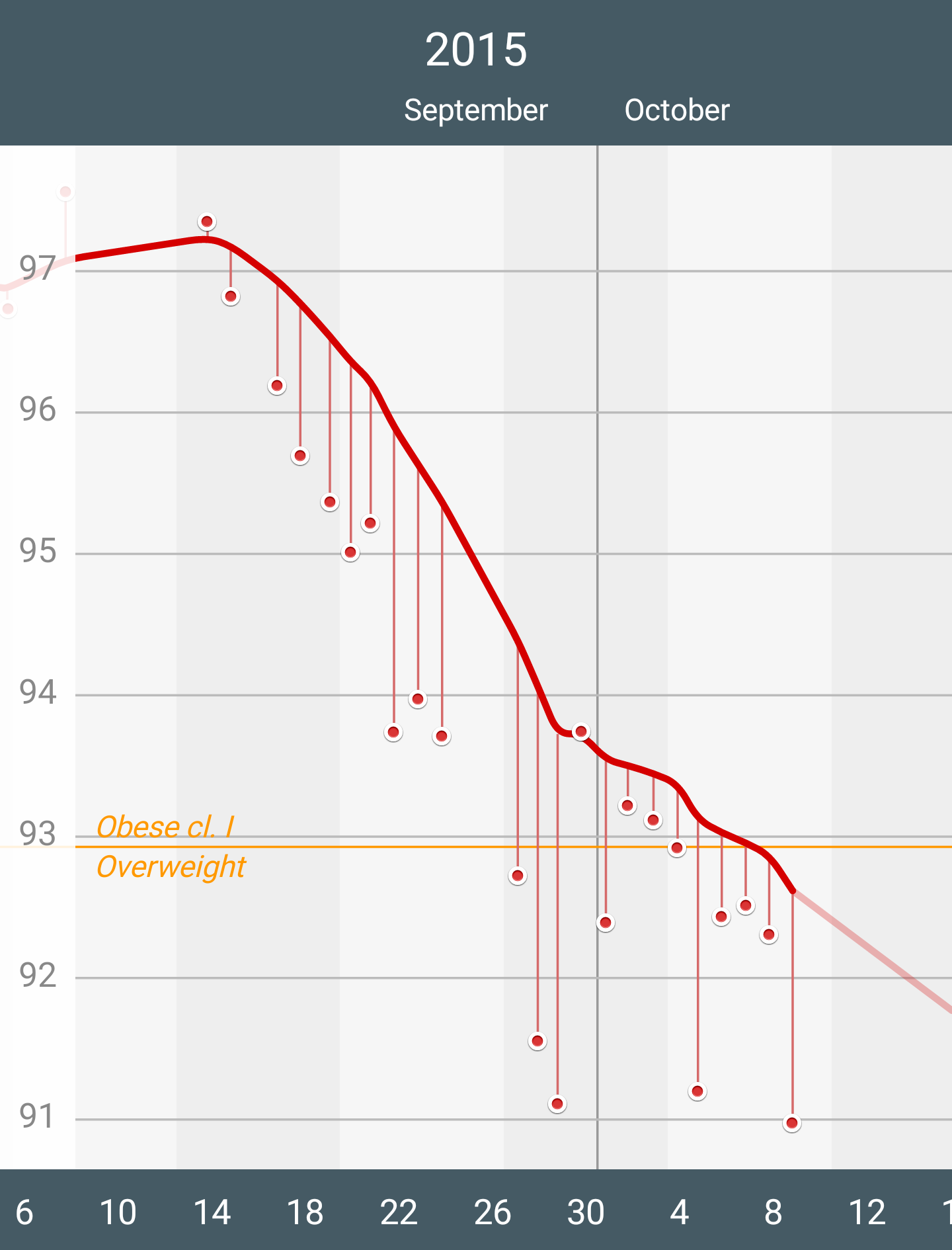
You can see quite clearly from this chart how the individual weights have jumped all over the place, but the trend has remained pretty steady and has consistently shown a decrease in weight. Okay, there was one point where it hit the trend exactly which gave me a little bit of a flat line, but overall I think this is much nicer way of looking at weight loss.
For example, if you remove the trend line and only have the individual data points and then plot a line between them, you will see a lot of ups and downs, which are likely to be very disheartening for dieters - including myself. The trend takes that out of the equation. Yes it’s nice to see the number on the scales, but the trend puts that number into perspective. The further away from the trend it is, the more unlikely that weight is “real” and you can expect it to reverse the next day. This is fine if you have a trend to show you that and that is why I really like this software!
Summary
Losing weight can be something of an emotional rollercoaster. Been there and done that. It’s hard to stay motivated when you eat and drink what you’re supposed to, abstain from all those delicious foods at your friends party, and then the next day you’ve put on a kilo. It’s about that time when people think screw this and go and order a big mac and fries. Again, I understand that - I’ve been there and done it.
Now I do want to be clear here. I see this as a tool for helping people stay on track. Although I’m concerned about health, I am also concerned about my weight and the big precursor for switching to the Starch Solution is that I was obese (since fixed, even if only just as you can see in the above chart). Even with starchy goodness, you’ll still see your weight flip flop. Tracking the trend removes that noise and shows you how you’re really doing, and that little bit of information might just be all you need to focus and stay on track.